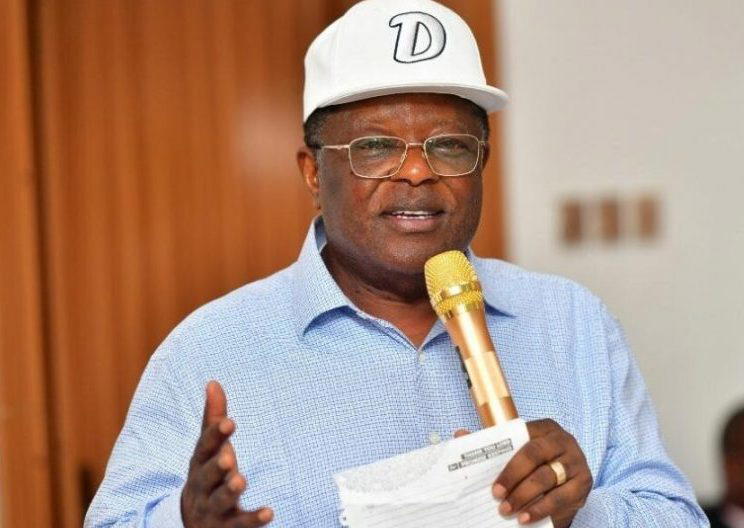
Umahi
By Jeff Agbodo
Minister of Works, Senator David Umahi, has said that the superhighway projects embarked upon by President Bola Tinubu, when completed, will attract economic benefits for the South East geopolitical zone.
Umahi stated this during the inspection of various projects being handled by the federal government in Ebonyi State, ranging from roads, flyovers, and bridges.
He urged the people of the South East to support President Tinubu’s second-term ambition in 2027, saying that Tinubu has addressed South East infrastructure decay within three years.
He said, “This section, from Calabar down towards the new corridor, is part of the first stretch of the 465-kilometre Trans Sahara road project initiated by President Bola Ahmed Tinubu. The major contracts are being handled by indigenous contractors. For instance, this 23-span structure you are seeing was awarded earlier before the main contract.
“The project is being executed by indigenous contractors, and I must say I am very satisfied with both the speed and the quality of the work. One significant thing to note is that this contractor has not even been mobilised—no kobo has been paid to him yet. That is the reality with many indigenous contractors. At least eight of them working under the Federal Ministry of Works have demonstrated the capacity to work without mobilisation.
“Unlike some expatriate firms that spend time studying the political situation or checking newspapers and public statements before moving ahead, these indigenous contractors simply get to work. They see themselves as partners in nation-building. Firms like Hitech and others have shown commitment, and we are proud of them.
“Nigerians should have confidence in our local contractors. The dream of President Tinubu is that indigenous contractors should be encouraged and supported, and that vision is gradually being fulfilled. If you look closely, you cannot tell the difference between what indigenous contractors are doing and what expatriate contractors are doing.
“For example, the ongoing dualization of the Enugu–Abakaliki road was made possible because the governor paid compensation to affected property owners. When contracts are yet to be mobilised, contractors cannot handle compensation themselves, so the support of the state government becomes crucial.
“The project starts from Calabar and stretches from Ndibe Beach. From there, it passes through Afikpo, Amasiri, and Onueke, before branching through the South–South and Southeast corridors and eventually connecting to Ukwachi.
“From Ukwachi, it links to the old Enugu–Abakaliki road, continuing through Mbeke Ishieke and terminating at the boundary between Ebonyi and Benue states.
“Section One of the project covers 125.5 kilometres, and the total contract sum is about ₦454 billion. Out of this amount, 30 percent has already been paid by the President. The road construction will begin with three lanes, while plans are underway to procure and construct the second carriageway.
“From the Ebonyi–Benue boundary, Section Two will continue to the Oweto Bridge, bypassing Kogi and connecting into Nasarawa State. The entire legacy project is about 465 kilometres, eventually linking up to Abuja. From Abuja, there are already existing routes leading to Akwanga.
“The Fourth Legacy Project initially covered 439 kilometres, but the President recently directed that an additional 330 kilometres be added, extending the road from Bauchi to Gombe, and further into Borno State. With this extension, the fourth legacy corridor will span about 750 kilometres.
“So far, about 120 kilometres of the fourth legacy project, ending in Gombe, has already been awarded, and work has commenced.
“The current project is being handled by West Infost, the same contractor working on the Abuja–Kano Federal Highway, where impressive progress is also being recorded. The quality of work they are delivering is very satisfactory.
“When you reach Abomege, there is a section where we directed that the road should be dualised—one kilometre forward and one kilometre backwards.
“The work being done here is fantastic. In fact, this is one of the most significant projects currently being undertaken by the President in the Southeast.
“Another major project is the Second Niger Bridge Bypass, which costs about ₦170 billion and covers 17.5 kilometres in dual carriageway, with work progressing well.
“Similarly, the Enugu–Onitsha Road project has been divided into sections. One section covers 107 kilometres, being executed by MTN under a tax credit scheme, while the remaining 92 kilometres is being constructed with concrete pavement by SKCC. That section is already about 50 percent completed.
“We also directed that the last 23 kilometres of the Enugu–Onitsha road, previously designed with asphalt, should be converted to concrete, because concrete pavement has come to stay due to its durability. The contractor handling this project has demonstrated commitment similar to firms like Hitech, particularly in terms of quality, partnership, and adherence to project standards.
“Currently, about 11 kilometres of the dual carriageway have already been completed. However, since the project started late, we have directed the contractor to establish another concrete plant at Onueke and begin paving from that end as well.
“By Monday, two construction fronts must begin simultaneously—one starting from Onueke moving backwards, and the other from Abomege, once houses and properties in that area have been cleared.
“We will also proceed to Chainage Zero at Ndibe Beach work being done by CGC, which is also delivering a very impressive job. However, the road will only be fully functional when the connecting bridge is completed. Once that happens, the 125-kilometre stretch will connect seamlessly to the Lagos–Calabar Coastal Highway, creating a continuous transport corridor.
“All the four legacy projects of the President are designed to interconnect, forming a strategic national road network. Regarding contract variations, we are not paying any variation to contractors. Every contract has its ups and downs. When the exchange rate stabilised, nobody asked us to reduce contract prices, so contractors must also make sacrifices during challenging times.
“With the quality of materials being used, the road is expected to last about 100 years without major maintenance.
“The official completion period is 36 months, but based on the pace of work, it is possible that the project could be completed within two years. Eventually, the second carriageway will also be constructed, just as with the other legacy projects.
“Under the Engineering, Procurement, Construction and Finance (EPC+F) model being used, the Federal Government pays 30 percent of the cost, while the contractor secures loans for the remaining 70 percent.
“After completion, the road will be tolled so that the contractor can recover the financed portion. Already, investors are competing for the opportunity to manage tolling on some of these highways.
“The President’s vision is not just about building roads but about strategic national investment. Along these corridors, land will be acquired and developed for factories, tourism centres, housing estates, and industrial clusters.
“The tolling system will also include solar-powered lighting, CCTV surveillance, and dedicated security monitoring, ensuring that the roads remain safe for users.
“These projects are therefore not just roads; they are economic development corridors designed to transform the country’s infrastructure and stimulate growth,” Umahi stated.

Comments
Please login to leave a comment.
No comments yet. Be the first to share your thoughts!