
Ship owners urge Dangote, others to back indigenous shipping with cargo deals
Key Takeaways30-sec read
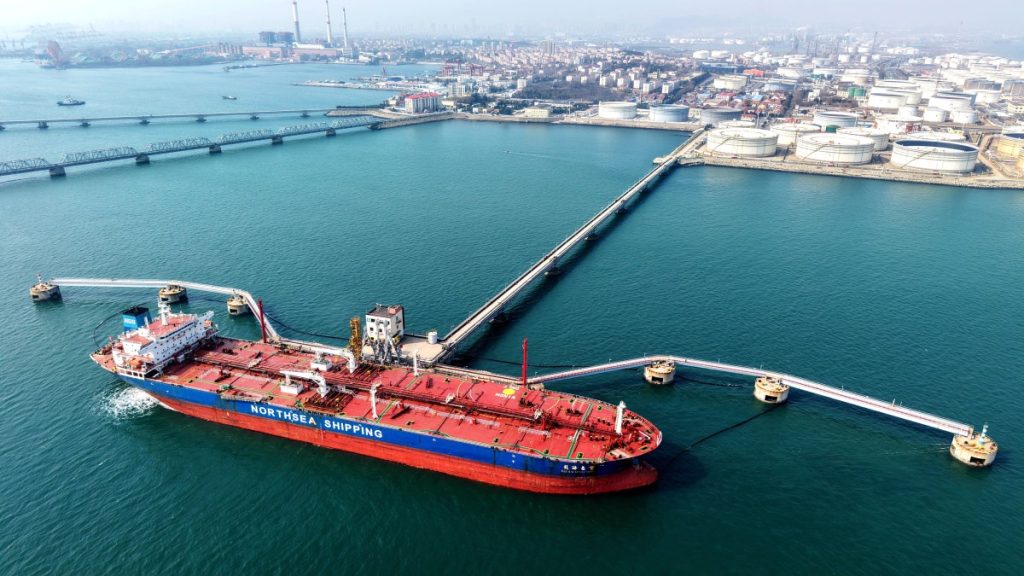
- n n An oil tanker unloads crude oil at a terminal at the port in Qingdao, in China’s eastern Shandong province on March 10, 2026.
- n Former President of the African Ship-owners Association (ASA), Nigerian chapter, Capt.
- Ladi Olubowale, made the call at a Public-Private Dialogue with Chief Executives, organised by the Nigerian Chamber of Shipping in Lagos.
An oil tanker unloads crude oil at a terminal at the port in Qingdao, in China’s eastern Shandong province on March 10, 2026. (Photo by CN-STR / AFP) / China OUT / CHINA OUT
nBy Providence Ayanfeoluwa
nIndigenous ship-owners have called on major cargo owners, particularly Dangote Group, to support Nigerian fleet development through long-term Contracts of Affreightment (CoAs).
nFormer President of the African Ship-owners Association (ASA), Nigerian chapter, Capt. Ladi Olubowale, made the call at a Public-Private Dialogue with Chief Executives, organised by the Nigerian Chamber of Shipping in Lagos.
nHe said predictable cargo contracts would enable indigenous ship owners to secure financing and acquire vessels, stressing that “shipping follows cargo.”
nOlubowale said: “Give credible Nigerian shipowners long-term Contracts of Affreightment, and those contracts become the commercial foundation upon which vessels can be financed, acquired and deployed”.
nHe urged Dangote Group, including the refinery, cement, fertilizer and other industrial operations, to allocate part of its cargo requirements to qualified Nigerian shipping companies under multi-year CoAs.
nAccording to him, such contracts would give shipowners the predictable revenue needed to approach banks, development finance institutions, leasing companies and other financiers for vessel acquisition.
n“There is no structural reason why Nigerian companies should not ultimately own and operate Suezmax tankers and other large commercial vessels. But fleet development must be connected to cargo, finance, technical capability and long-term employment,” he said.
nHe said the proposed model should be built around four pillars — cargo, contract, finance and vessel — with government providing the enabling regulatory environment while the private sector drives investment and fleet expansion.
n nReader Reactions12 votes
What is your take on this story? Tap an emoji to react.
Related Stories
 Business & Economy
Dangote Refinery Raises Alarm Over 22 Sabotage Attempts by Nigerian Workers
By RealNaijaGist News Reporters rnDecember 19, 2025rnrnDangote Refinery has raised serious concerns over what it described as unpatriotic and delibera
 Business & Economy
Rabiu, Elumelu strengthen partnership as BUA Foods hits N1.77tn revenue
A meeting between leading Nigerian industrialist, Abdul Samad Rabiu, and banking executive, Tony Elumelu, has signalled renewed collaboration between capital and industry, as BUA Foods posted strong financial results for 2025. Rabiu, founder and chairman of BUA Group, hosted Elumelu and his execu...
 Business & Economy
NNPCL Pledges to Make a Difference in the Lives of Over 200 Million Nigerians
The NNPC Limited has reaffirmed its commitment to improving lives across Nigeria, stating that its success is measured not only by oil production but also by the number of people positively impacted.n