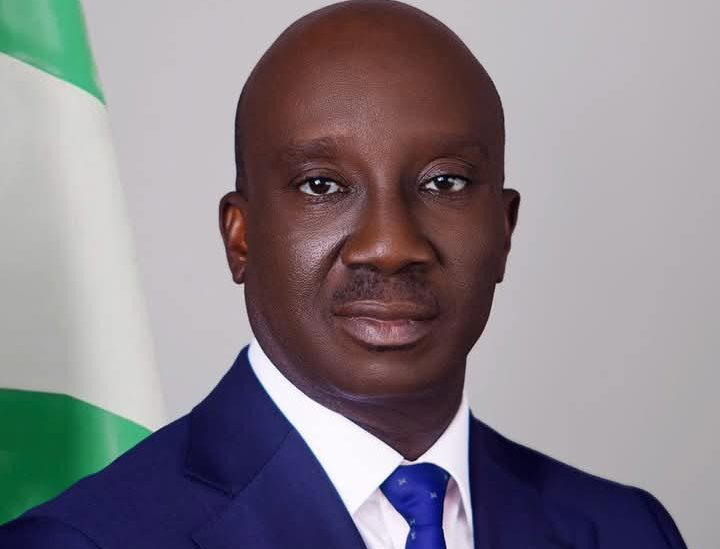
Governor of Edo State, Monday Okpebholo
By Paul Ade-Adeleye
I did not come to Governor Monday Okpebholo’s administration with applause . I came with a raised eyebrow. Before his election into the executive seat of Edo State, I was not sold on the man. I had seen too many promises dressed in fine agbada and too many campaigns that could talk a good game but could not put gravel where there was mud.
Indeed, the former governor of the state was sold to us as a technocrat and I thought he would be like the frontend developer to put an interface to the backend work of former governor Adams Oshiomhole but he ended up being underwhelming.
So, I did what any careful observer should do this time around; I watched closely. Not from the noisy marketplace of partisan excitement, but from that quieter corner where one waits for the dust to settle and the facts to begin speaking for themselves.
Now, more than a year into his tenure, I can say this much without choking on my own words: the governor appears to have settled on roads as the spine of his development argument. And in a place like Edo, that is no small thing.
Roads are not merely strips of tar and stone. They are the veins through which commerce travels, the bridges between farms and markets, the difference between isolation and access, between movement and stagnation. When roads fail, communities do not simply complain. They shrink. Economies stiffen. Daily life becomes a wrestling match with distance.
What catches the eye in Edo is that the current road push is not being sold as one giant miracle project or as a single contractor’s parade. It is taking shape as something more layered, more thought through, more deliberate.
There seems to be a three-part working model behind it. First, the state is pushing some construction capacity downward to local government councils. Second, it is trying to build a quicker maintenance and emergency-repair system. Third, it is reserving bigger and more technically demanding corridors for established construction firms.
In plain terms, the approach looks like this: decentralised delivery even down to the councils, rapid intervention, and large-scale execution on the part of road construction firms. That distinction matters.
In government, one size rarely fits all, and when leaders pretend otherwise, they usually end up carrying water in a basket.
Take the first prong. Earlier this year, the Edo State government moved to hand over 54 units of construction equipment to the 18 local government councils. Reports indicated that these included graders, excavators, rollers, and other heavy-duty machines meant to support road building, drainage works, rural access, and other community infrastructure needs. The logic was not hidden behind bureaucratic grammar. This way, policies and hindrances, which hitherto had a field day delaying road projects were securely pinioned in favour of the grassroots drive for development.
By putting tools closer to the ground, the government says it wants to cut the bottlenecks that usually turn manageable problems into chronic wounds.
There is common sense in that. Road failure often begins as a local nuisance long before it becomes a statewide embarrassment. A collapsed drainage in one ward, a failing culvert in a farming settlement, a feeder road so battered that produce cannot leave the village without bruising both goods and patience, these things do not always require ribbon-cutting drama or a contractor with a convoy. Sometimes what they require is far simpler and far more urgent: machinery within reach, officials who cannot hide from the people affected, and responsibility placed near the scene of the trouble. If the shoe pinches, let the wearer be close enough to say so.
That is where decentralisation earns its keep. It takes some of the power to act out of distant offices and places it in the hands of councils that ought to know their terrain better than anyone else. Whether they will use that power well is another question, but as an administrative principle, it is harder to fault than the old habit of waiting for the capital to sneeze before the localities are allowed to breathe.
Then comes the second prong, and to my mind this may be the most revealing. It is one thing for a government to build roads. It is another thing entirely for it to respect maintenance. It is a bad habit to fall in love with groundbreaking ceremonies while treating maintenance like an unwanted stepchild. We praise the new and neglect the necessary. We wait until a road has gone from cracked to cratered before anyone begins to move. By then, the horse has bolted and the stable is on fire.
This maintenance-minded posture is reinforced by how the administration has reportedly supervised active sites. There have been reports of Governor Okpebholo directing contractors on ongoing road projects to work round the clock so that meaningful progress can be made before the heavy rains arrive in full force.
Projects such as Mechanic Road in Egor and the Catholic Charismatic Renewal Road in Ugbiyoko were mentioned in that context. Some may dismiss such directives as political theatre, but time is not a decorative element in road construction. In our environment, the rainy season is an unforgiving auditor. Weak, delayed, or half-finished work can be swept backwards in weeks. On this score, speed is not only a political virtue. It is an engineering necessity.
The third prong is where scale changes the conversation. Not every road can or should be handled at the council level, and not every job can be solved with emergency maintenance. Some projects are too large, too technical, too central to urban mobility to be managed with improvised arrangements. That is where established construction firms enter the picture.
The Ramat Park flyover in Benin City is the clearest example. When it was flagged off in November 2024, the state identified CCECC Nigeria Limited as the contractor and gave an 18-month completion timeline. By February 20, 2026, the project was said to be about 90 percent complete, with the governor expressing satisfaction at the pace and quality of work.
This is not ward-level patching. It is structural infrastructure, the kind that requires engineering depth, traffic coordination, organisational discipline, and a contractor capable of carrying a heavier load without dropping the ball.
The Utteh Palace Road project in Benin City offers another glimpse of this third layer. The 4.7-kilometre road, flagged off in December 2024, was assigned to Risen Fan, and the state connected it to broader inter-local movement, saying it would link Ikpoba-Okha to Uhunmwonde.
Here again, the pattern becomes clearer. The government does not appear to be throwing every problem into the same pot and hoping for soup. It is classifying roads by character and assigning them accordingly. Councils for local and distributed works. State-backed rapid response for maintenance and emerging failures. Major firms for the heavy lifting and headline connectors.
That, at least on paper and increasingly in practice, is a rational division of labour. There are signs that this pattern stretches beyond Benin City. In Akoko-Edo, reports indicated that preparations were underway for reconstruction work along the Auchi-Sasaro-Igarra-Aiyetoro-Uneme-Nekua-Ibillo-Ekor-Ikiran-Oke corridor, with local inspection activity preceding the larger execution. Even where not every contractor’s name is always in public view, the method remains visible enough: state ownership at the political level, local coordination where needed, and contractor-led delivery on key routes.
Still, it would be foolish to break into premature applause. A framework can look elegant on paper and still stumble in the field. Councils can misuse equipment or allow machines to rot in the weeds. Rapid-response units can become loud in press releases and quiet on the ground. Big contractors can miss deadlines, cut corners, or hide behind excuses if supervision goes soft.
In public works, the devil is not merely in the detail. Sometimes he is driving the bulldozer.
That is why the real measure of this model will not be the neatness of its design but the endurance of its outcomes. Roads must last. Machines must work. Councils must act. Contractors must deliver. Government must inspect not once for the cameras, but again and again until quality becomes habit rather than accident.
Yet even with those cautions firmly in place, one point stands out. What is emerging in Edo is not random motion. It is not governance by guesswork. It is an attempt at a coherent operating theory, one that recognises that different road problems require different tools. That may not be the final word on success, but it is certainly better than governing as though every crack in the road can be fixed by ceremony, slogan, or wishful thinking.
I began as a sceptic. I am not done watching. But I have seen enough to say this: when a government begins to understand that roads are not just projects but pathways to dignity, then perhaps it has at least put its foot on the right pedal. Whether it stays the course is the part history will judge.


Comments
Please login to leave a comment.
No comments yet. Be the first to share your thoughts!