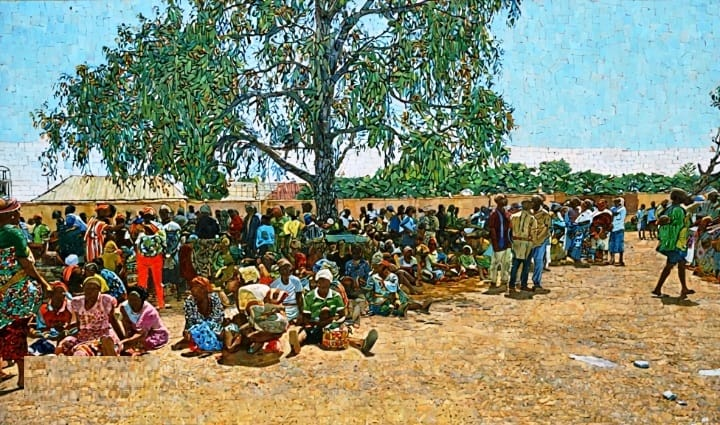
Before sunrise, the IDP camp in Bungha, Mangu LGA, stirs to life, its residents emerging from tarpaulin shelters that have become their temporary homes, a far cry from the village life they once knew.
In this camp, a mother tends to a small fire, while a baby cries in a makeshift cot, its mat still damp from the previous night's rain, as children make their way to a class under a tree, where a volunteer teacher may or may not be waiting.
Benue State is home to hundreds of thousands of internally displaced persons, with Nigeria as a whole carrying more than three million displaced people, and Benue alone accounting for almost half of this number, scattered across camps and forgotten settlements.
The state, known as the food basket of Nigeria, once had soil that fed millions beyond its borders, with farming being a way of life and a source of identity, but now, the land lies empty and silent.
A visit to an IDP camp reveals the stories of those who have been displaced, including Terdoo, who remembers his life before the crisis, when he would wake up before sunrise to tend to his farm, and his yam barns would be full, and his children would eat before they complained.
Terdoo's life was turned upside down when fear arrived, and he was forced to flee, leaving behind his farm and his home, and now he wakes up every morning with no fields to tend to, no barns to fill, and no certainty about his future.
In another part of the camp, Jerry tends to a small patch of vegetables, which she has managed to coax out of the stubborn soil, a small but significant achievement in a place where hope is hard to find.
For Jerry, the hardest thing about living in the camp is the night, when the memories of what she lost come flooding back, and she is reminded of the life she left behind, and the children she lost.
In the classroom under a tree, a small boy points to letters on a worn notebook, as his sister tries to copy each line, a moment of normalcy in a life that has been turned upside down by displacement and loss.
Jerry's story is one of resilience, as she finds ways to keep going, even in the face of overwhelming grief, and she says that what gives her strength is the fact that she wakes up every morning, and that sometimes, that is all she can do.
Teryima, another resident of the camp, says that when he sees children, he is reminded of his own children, who were killed in the violence that forced him to flee, and he feels a deep sense of loss and grief.
Teryima's message to those in power is simple: stop sending words, and instead, bring back their land, make it safe, and let them return without fear of being killed in their sleep, and he says that they are not asking for food or tents, but for their lives back.
The cost of the crisis in Benue is not just human, but also economic, as the state's fields lie abandoned, and markets that once carried life have thinned, leading to rising food prices, and a national wound that will take years to heal.
The persistence of the camps is not an accident, but the result of decisions not taken, and responsibilities not carried, and the failure of security to guarantee safe return, and the lack of resettlement plans, has left thousands of people in limbo.
As the 2027 elections approach, promises fill the air, but the camps remain, a stark reminder of the failure of the system, and the need for real action, not just words, to address the crisis.
Jerry says that if she could leave the camp today, she would go home, even if nothing is there, she would stand on that ground, and Teryima nods in agreement, saying that he wants to stand where his house stood, and that is enough to begin.
The memory of Yelwata, where more than 200 lives were lost in one night, does not leave the camp, and the grief of the residents is a testament to the devastating impact of the crisis, and the need for justice and accountability.
The camps have become a holding place for citizens who have done nothing wrong except survive, and the refusal of the nation to end the camps is a statement about the value placed on human life, and the importance of restoring security and rebuilding homes.
In Benue, time is no longer counted in years, but in rains that fall through broken roofs, and harvests that never come, and lives paused without consent, and each morning, the residents wake up again, not because life demands it, but because something in them refuses to end.
The fact that these camps have existed for so long that time has quietly rewritten entire lives within them is a troubling reality, and the fact that children who arrived in the camps as young children are now standing as adults in the same dust, their childhoods swallowed by waiting, is a devastating consequence of the crisis.
A whole generation is coming of age without roots, without land, and without the simple inheritance of belonging, and the most devastating part is that for many of them, this is the only life they have ever known, a life of displacement and loss.
Ending the camps is not charity, but responsibility, and it means restoring security, rebuilding homes, reopening farmlands, and protecting the land that feeds the country, and refusing to accept displacement as a permanent condition of Nigerian life.
Until that happens, every campaign promise will ring hollow, and every policy speech will be incomplete, because somewhere in Benue, under plastic roofs and uncertain skies, thousands are not asking for sympathy, but for something far more difficult to ignore, the right to go home.
Until they can stand on the ground that is theirs, Nigeria is not whole, and the nation will remain troubled by the knowledge of its failure to protect its citizens, and the refusal to end the crisis that has left so many without a home, and without a future.


Comments
Please login to leave a comment.
No comments yet. Be the first to share your thoughts!