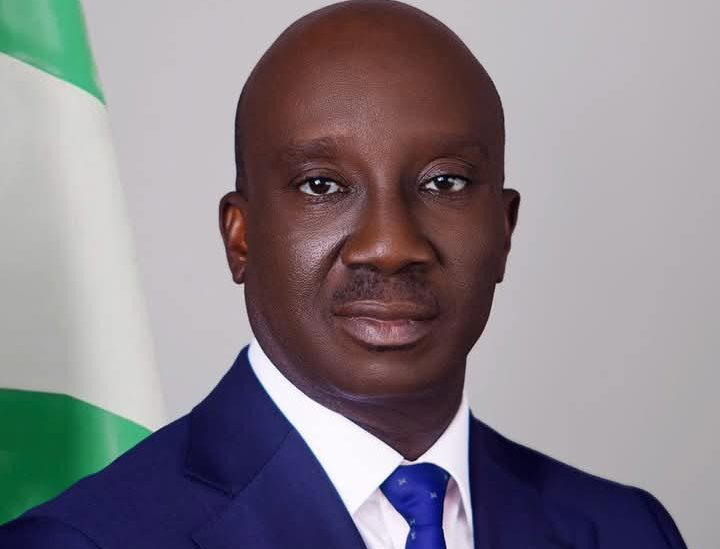
Infrastructure development is a crucial responsibility for governments, especially in developing economies where road networks play a vital role in commerce, mobility, and social interaction, a fact that is not lost on Governor Monday Okpebholo of Edo State.
Okpebholo has implemented a multi-faceted approach to address road infrastructure challenges across Edo State, with a focus on Edo South, Edo Central, and Edo North, making his administration's commitment to road construction and rehabilitation increasingly visible.
The governor's strategy is built around a three-pronged model, which empowers local government councils to handle grassroots roads, establishes a rapid response mechanism for road maintenance and emergency repairs, and engages reputable construction firms for major road projects.
This approach is designed to ensure that road construction, maintenance, and rehabilitation occur simultaneously across different levels of Edo State's transportation network, recognizing that functional roads are the backbone of economic growth and development.
Years of neglect had left many roads in Edo State in poor condition, hindering mobility and limiting economic productivity, prompting Okpebholo's administration to place infrastructure development at the centre of its governance SHINE agenda.
The state government has initiated numerous road projects across the state, covering strategic urban roads, inter-community corridors, and major transportation routes, aiming to improve mobility and stimulate economic activity.
A key component of the governor's strategy is empowering local government councils to play an active role in grassroots road development, with the state government recently handing over 54 construction equipment to the 18 local government councils in Edo State.
This initiative enables councils to undertake grading, rehabilitation, and maintenance of roads within their communities, strengthening decentralization in infrastructure development and allowing residents to engage directly with their local councils on road issues.
The state government has also established a Rapid Response Road Maintenance mechanism within the Ministry of Works, which was restored by Governor Okpebholo, reversing the previous administration's decision to merge it into the Ministry of Roads and Bridges.
The Ministry of Works has been equipped with light and heavy-duty equipment to support road maintenance and emergency repairs, allowing government maintenance teams to quickly intervene when roads develop potholes, erosion problems, or drainage failures.
The governor's strategy involves engaging reputable construction companies to execute large-scale and technically complex road projects, with several strategic road projects currently being handled by established engineering firms, including China Civil Engineering Construction Corporation (CCECC), BRASS Engineering and Construction Nigeria Limited, and Place of Peace Investment Limited.
Other companies involved in road projects in Edo State include Rawtech Nigeria Limited, Heartland Nigeria Limited, and NAFRO Nigeria Limited, working on projects such as the Old Sapele Road, Temboga–Ekiuwa–University of Benin Road, and the Benin Technical Road Project.
The administration has also initiated major road projects outside Benin City, including the Ekpoma–Irrua–Udomi–Ubiaja dualisation, the construction of UNEWA Road in Uromi, and the Illeh–Uko Road.
The state government has maintained a cooperative relationship with the Federal Government, enabling Edo State to take over and reconstruct some federal roads within the state, such as Sapele Road in Benin City, where reconstruction works are currently progressing.
A defining feature of Governor Okpebholo's infrastructure policy is strict oversight and accountability, with the governor emphasizing that contractors must deliver projects according to agreed timelines and quality standards, and regular inspection visits to project sites ensure that contractors remain committed to their responsibilities.
The benefits of improved road infrastructure extend far beyond transportation, improving access to markets for farmers, reducing travel time for commuters, and supporting the growth of businesses across the state, while also benefiting students, healthcare providers, and emergency services.
Governor Okpebholo's three-pronged strategy represents a comprehensive approach to infrastructure development, addressing road infrastructure challenges at multiple levels and gradually transforming Edo State's road network, improving connectivity and laying the foundation for sustainable economic growth.

Comments
Please login to leave a comment.
No comments yet. Be the first to share your thoughts!