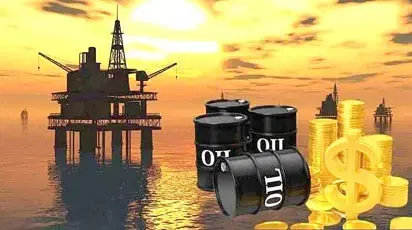
Oil prices experienced a significant surge on Thursday, while the majority of stock markets declined, as investors carefully considered the prospects of a fragile Middle East ceasefire and the re-opening of the Strait of Hormuz, a crucial waterway for oil and gas shipments.
Traders were also securing profits from the previous day's relief rally, as the first-quarter earnings season commenced, which is expected to reveal the war's impact on company results worldwide.
Global equity markets had risen sharply and crude oil futures had plummeted on Wednesday, following US President Donald Trump's announcement of a two-week halt in the war against Iran, and Tehran's declaration that it would reopen the waterway transporting one-fifth of the world's oil and gas.
However, the ceasefire has been cast into doubt, largely due to Israel's ongoing attacks against Iran-backed Hezbollah in Lebanon, and Tehran has also stated that it will impose a toll on ships transiting Hormuz.
The main US oil contract, West Texas Intermediate, rebounded by over five percent to reach almost $100 a barrel, as international calls mounted for the ceasefire to be extended, after a massive wave of Israeli strikes on Lebanon resulted in the deaths of more than 200 people.
Aarin Chiekrie, equity analyst at Hargreaves Lansdown, noted that "Oil prices will likely remain elevated and choppy until a more permanent agreement is struck between all parties".
Anthony Kettle at RBC BlueBay Asset Management cautioned that "Even if the ceasefire holds, it will take time for energy exports from the region to return to more normalized levels, so there will be an impact on growth and inflation that is still difficult to ascertain".
Kettle also stated that "It should also be noted that there has been significant damage to infrastructure in some major energy exporters".
Wall Street stocks opened with losses, following declines on Europe's main stock markets and across much of Asia.
Ahead of the first-quarter earnings season, Chiekrie said "While progress towards a more permanent resolution in the Middle East will dominate short-term market moves, it's earning power that drives stock prices in the long term".
Some companies have already begun alerting markets to the impact of the war on their earnings for the January-March period, with the conflict having started on February 28.
At around 1350 GMT, key figures showed Brent North Sea Crude up 3.5 percent at $98.03 a barrel and West Texas Intermediate up 5.3 percent at $99.41 a barrel.
The New York stock markets were down, with the Dow Jones at 47,834.24 points, the S&P 500 at 6,773.46, and the Nasdaq at 22,590.01.
European markets also declined, with the London FTSE 100 down 0.2 percent at 10,590.51, the Paris CAC 40 down 0.8 percent at 8,198.43, and the Frankfurt DAX down 1.5 percent at 23,713.29.
Asian markets closed lower, with the Tokyo Nikkei 225 down 0.7 percent at 55,895.32, the Hong Kong Hang Seng Index down 0.5 percent at 25,752.40, and the Shanghai Composite down 0.7 percent at 3,966.17.
Currency exchange rates showed the euro/dollar up at $1.1685 from $1.1667 on Wednesday, the pound/dollar up at $1.3417 from $1.3405, and the dollar/yen up at 159.04 yen from 158.35 yen, while the euro/pound was down at 87.10 pence from 87.22 pence.



Comments
Please login to leave a comment.
No comments yet. Be the first to share your thoughts!