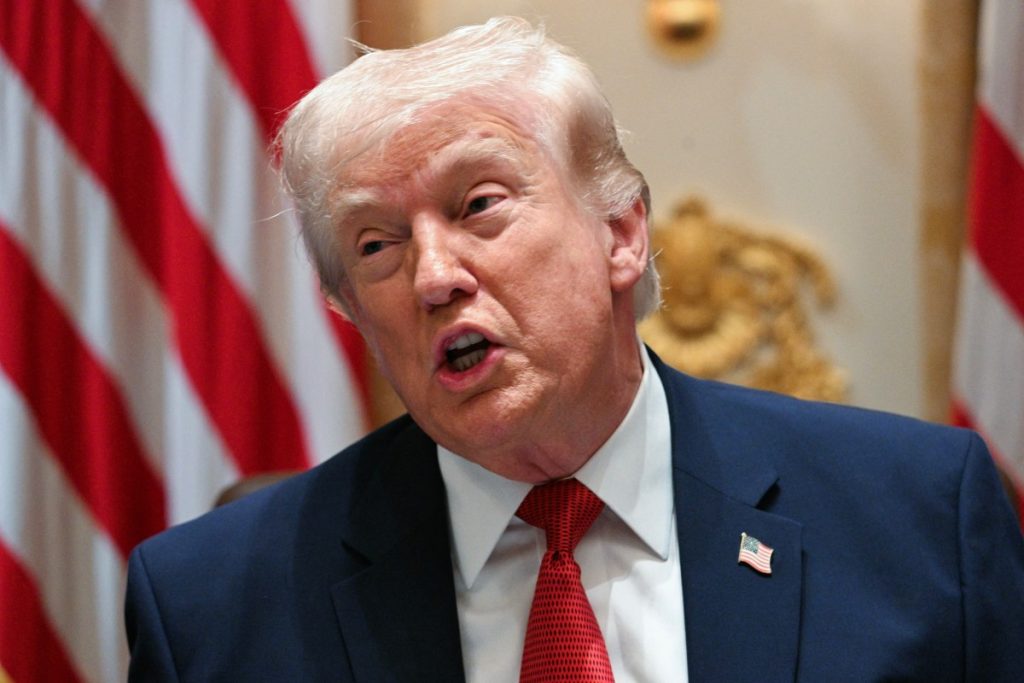
The White House has initiated an examination of Iran's latest proposal to unblock the Strait of Hormuz, a move that comes two months after a US and Israeli offensive sent shockwaves through the global economy.
Peace talks between the United States and Iran, aimed at ending the Middle East war and fully reopening the vital strait, have so far proven inconclusive since a ceasefire came into force.
On Monday, Trump met with top security advisors to discuss an Iranian proposal, which was conveyed to Washington via Pakistan, outlining Tehran's red lines in negotiations, including on nuclear issues and the Strait of Hormuz, as reported by the Fars news agency.
The proposal is "being discussed," according to White House spokeswoman Karoline Leavitt, who provided an update during a White House briefing.
Secretary of State Marco Rubio expressed cautious optimism about the proposal, telling Fox News that "it's better than what we thought they were going to submit," but questioned the sincerity of Iran's intentions.
Rubio emphasized the need for a deal that "definitively prevents them from sprinting towards a nuclear weapon at any point," highlighting a key condition for the United States.
Iran's top diplomat, Abbas Araghchi, blamed Washington for the failure of peace talks during a visit to Russia, where President Vladimir Putin pledged Moscow's support in ending the war.
Araghchi stated that "the US approaches caused the previous round of negotiations, despite progress, to fail to reach its goals because of the excessive demands," highlighting a major obstacle in the negotiations.
Araghchi's visit to Russia followed stops in Oman and Pakistan, the main mediator in the Middle East war, which had hosted a first, unsuccessful round of US-Iran talks.
US President Donald Trump cancelled a planned trip by his envoys Steve Witkoff and Jared Kushner, but told Fox News that if Iran wanted talks, "they can call us," and added that the cancellation does not signal a return to hostilities.
Tehran would first need guarantees that Washington and Israel would not attack again if it was to offer security assurances in the Gulf, according to Iran's envoy to the UN.
In Saint Petersburg, Putin and Araghchi both voiced their commitment to their countries' "strategic relationship" following their meeting, underscoring the strong ties between Russia and Iran.
Araghchi noted that the war, which began when the United States and Israel attacked Iran on February 28, demonstrated "Iran's true power" and stability.
However, back in Tehran, the mood was more subdued, with small business owner Farshad telling Paris-based AFP journalists that "everything in the country is up in the air right now" and that "the country is in complete economic collapse."
The US-Iranian ceasefire holds, but the war's economic shock waves continue to reverberate, with Tehran resident Shervin, a photographer, feeling the pinch and struggling to make ends meet.
Shervin, 42, said "it is the first time that I have reached a point where I was late on my rent" and that he still doesn't have any projects, highlighting the economic difficulties faced by many Iranians.
Iran has blockaded Hormuz, cutting off flows of oil, gas, and fertiliser, and sending prices soaring, prompting the United States to impose a blockade of Iranian ports in response.
Trump faces domestic pressure to find an off-ramp as fuel prices rise, with midterm elections due in November and polls showing the war is unpopular among Americans.
Iran's Revolutionary Guards say they have no intention of easing their market-rattling chokehold of the strategic waterway, with Ebrahim Azizi, head of the national security commission in Iran's parliament, proposing a law for managing the strait.
The proposed law would make the Islamic republic's armed forces the overseeing authority, with levies to be paid in Iranian rial, according to Azizi.
However, the head of the UN's maritime agency, Arsenio Dominguez, said there was "no legal basis" for imposing transit fees, a view shared by Secretary of State Marco Rubio.
Rubio rejected the idea, stating that "they cannot normalise — nor can we tolerate them trying to normalise — a system in which the Iranians decide who gets to use an international waterway, and how much you have to pay them to use it."
Violence has continued on the war's Lebanese front, despite a recently extended ceasefire between Israel and Iran-backed Hezbollah, with Beirut's health ministry reporting that Israel killed four people in the south.
Fifty-one others were wounded, including three children, according to the ministry, highlighting the ongoing humanitarian toll of the conflict.
Hezbollah's leader Naim Qassem rejected planned direct negotiations between Lebanon and Israel as a "grave sin," vowing to "not back down" and sparking a strong response from Israel.
The Israeli military said it had begun hitting Hezbollah targets in Lebanon, with Israeli Prime Minister Benjamin Netanyahu stating that Hezbollah's rockets and drones remained a threat meriting military action.
Israeli Defence Minister Israel Katz warned that "Qassem is playing with fire," highlighting the risks of escalation in the conflict.
Lebanese President Joseph Aoun responded to Qassem, stating that his "goal is to reach an end to the state of war with Israel," but Israeli army chief of staff Eyal Zamir predicted that 2026 was "likely to be another year of fighting" for Israel on all fronts.
Comments
Please login to leave a comment.
No comments yet. Be the first to share your thoughts!