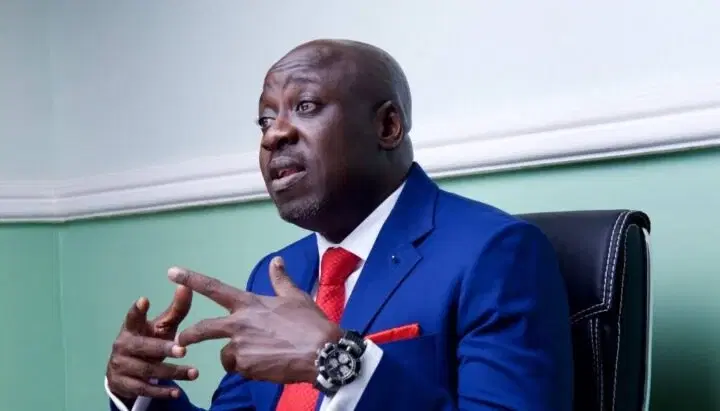
ADC National Publicity Secretary, Bolaji Abdullahi
By Luminous Jannamike
The African Democratic Congress, ADC, on Thursday launched a fresh political mobilisation drive ahead of the 2027 elections, declaring that ‘age is not a credential’ for leadership and blaming Nigeria’s older political class for the country’s worsening crisis.
The message framed the unveiling of the Rise Up Naija Movement, RUN, in Abuja, where ADC leaders and supporters presented the initiative as a platform for youth participation, active citizenship and issue-based politics amid growing frustration over insecurity, economic hardship and declining public trust in government.
Among those who spoke at the event were ADC National Publicity Secretary, Bolaji Abdullahi; the party’s founder and pioneer national chairman, Ralph Nwosu; National Coordinator of the Rise Up Naija Movement, Aliyu Audu; and politician and businessman, Kashim Imam.
“There is one message I’m going to leave you here with. Age is not a credential. Birth certificate is not a credential. It is the work we do going forward that will determine our place in the history of the Federal Republic of Nigeria,” Abdullahi said.
He said Nigeria’s political troubles were rooted in years of destructive political culture, arguing that the country could not expect meaningful change from politicians shaped by the same system for decades.
“We are in the mess we are in because of the kind of politics we have played over the years,” he said.
He said the political class had failed to prepare a successor generation and had damaged public trust in politics so badly that many Nigerians now viewed politicians with deep suspicion.
“We, the political class in the older generation, we never really thought of a successor generation. We’ve allowed politics to be given a bad name,” he said.
In one of the event’s sharpest political attacks, Abdullahi said the ruling All Progressives Congress, APC, was held together largely by access to power rather than ideology.
“I have no doubt in my mind that the only thing holding the APC together today is power. When you take government power out of APC, you don’t have a political party,” he said.
He described the ADC as ‘the future of politics in Nigeria,’ saying the party was built around ideas, internal debate and inclusion instead of the dominance of powerful individuals.
Also speaking, Nwosu said Nigeria’s biggest achievements in recent decades had been driven largely by young people, insisting that the country’s political future depended on their involvement.
“All the successes we have recorded for almost the last 20 years has to do with our young people. Wherever Nigeria has come first, be it music, theatre, art or scholarship, it has been about the young people,” he said
Nwosu acknowledged the growing despair across the country but said he remained convinced that politically engaged youths could still change Nigeria’s direction ahead of 2027.
“At this point, people are going to say it’s almost hopeless for Nigeria. But seeing these young persons here gathered, and you decided to take it on your own to correct the wrong, I’m sure that in 2027 we’re going to get it right,” Nwosu said.
On his part, Imam blamed Nigeria’s troubles on what he described as irresponsible leadership despite the country’s vast human and natural resources.
“What is the problem? Irresponsible leaders. That is our major problem as a nation,” he said.
He said the ADC was determined to build a different political culture centred on accountability and inclusiveness, adding that anyone seeking office on the party’s platform must embrace that vision.
“You must commit to ending the corruption, the crime that has been the root of our problems in this country. We must do things differently,” he said.
Imam admitted that the older generation had failed younger Nigerians.
“I’m ashamed of my generation. We failed Nigerians. We failed the youths. We are bad role models,” he said.
Earlier, Audu said the Rise Up Naija Movement emerged from growing anger and disappointment among Nigerians over economic hardship, insecurity, weak institutions and fading confidence in leadership.
“Today is not merely the unveiling of another political platform. Today is the unveiling of a national awakening,” he said.
According to him, the movement would mobilise professionals, entrepreneurs, artisans, students and community leaders around accountability, inclusion and national unity.
“We believe governance must move beyond empty promises to measurable progress. Beyond slogans to solutions. Beyond division to unity. Beyond politics for power to politics for people,” Audu said.
He added that Nigeria’s future would depend on citizens willing to participate and lead.


Comments
Please login to leave a comment.
No comments yet. Be the first to share your thoughts!