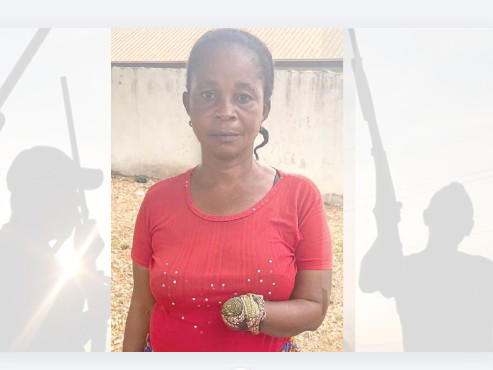
When the rain began to fall that afternoon in Mbagwen Udei, there was no warning of the horror that was about to unfold. For Martina Atom, a 45-year-old mother of four, it was just another day in the farm, another day of bending over crops beneath a cloudy Benue sky; another day of trying to till the soil for food to feed her children. But within moments, her world collapsed and swept away her hope, joy and distorted her physique and way of life forever.
While she went to the farm to work and raise money for her family, she was brought home in tatters, almost lifeless. She had been broken into pieces by those who ambushed and brutally attacked her and left her in her pool of blood satisfied that she was dead and gone.
But, rare courage and trust in her God still kept the farmer from giving up the ghost that fateful afternoon. She is still alive, though her attackers had long concluded that she had gone to the great beyond. Today, eight years later, Martina lives in a shelter at the Daudu II Internally Displaced Persons, IDPs, camp in Guma Local Government Area of Benue State. Her left arm hangs without a hand, but a neatly wrapped stump. Her eyes, however, are not empty.
They carry pain, but also a quiet strength that refuses to die. “I was in the farm when they came,” she recalls softly. Armed herdsmen had stormed her community. The attack was swift and merciless. Gunshots and screams tore through the air. Villagers ran in different directions, each person in the frantically searching for where to hide from the merciless attackers. “They met me in the farm. I ran, but the rain had made the soil slippery.”
She slipped. One of the attackers caught up with her. As he raised his machete, Martina instinctively lifted her hand to shield her head. The blade came down. It did not kill her, but it severed her hand. “They used a machete on my head, but I used my hand to protect myself,” she recalled as she fought back tears. “The machete landed on my hand and chopped off my hand.” Bleeding heavily, Martina collapsed into the mud. Around her, the attackers argued.
Some wanted to finish her off. “As God would have it, they agreed to leave me. Some of them said I would die anyway.” They abandoned her in her pool of blood, assuming nature would complete their work. But Martina Atom did not die. Summoning strength from somewhere beyond human explanation, she dragged herself up in extreme pain. She found her severed arm in the mud. And then, in an act that defied imagination, she carried it home. “I picked up the arm and took it back. They had retreated after the attack. I gave it to my son who luckily survived the attack, to bury.
That is how I have been living with one hand.” It is difficult to comprehend such composure in the face of such brutality. Yet for Martina, survival has never been optional. It has always been necessary, for her four children. Eight years have passed since that day. Eight years since she fled Mbagwen Udei. Eight years of living not in a home, but in a camp. Daudu II IDPs camp has become a refuge for thousands displaced by persistent attacks across Benue communities. For Martina, it is both a sanctuary and prison, a place of safety from violence, but also a space where dreams die and futures stall. She shares a cramped shelter with her children. Her eldest is 13. The youngest is seven. They were small when they fled. Now, they are growing up in displacement.
We have been living here and cannot go back home. The armed herders are still in our community,” Martina said. Lamenting the absence of her husband she said: “I do not know where my husband is. He abandoned us years ago. And for us, without my husband, life in the camp is survival reduced to its barest form.” With only one hand, Martina cannot farm the way she once did. She cannot carry heavy loads or engage in many forms of manual labour. The injury that was meant to end her life has instead become a daily reminder of her vulnerability. To feed her children, she visits local markets where grains are sold. When traders finish measuring and bagging rice, maize, or millet, the rejected grains, swept aside as waste, are left behind. “I go to the markets. I sift what they reject.
From that, I get something edible.” It is a painstaking process. Bent over with one hand, she separates stones and dirt from grains others have discarded. What remains becomes dinner. Some days are better than others. Some days, there is nothing. Yet her children cling to her. In the evenings, when the camp grows quieter, Martina’s small family gathers close. In that fragile circle, she is mother, father, protector, provider, all with one hand. What hurts her most is not the loss of her arm. It is the loss of her children’s education. “Life has not been easy for us in the camp. Even my children are not attending school,” she said. Her eldest should be in secondary school. Instead, he helps her fetch water and watch over his younger siblings. The younger ones roam within the camp. Education, once a simple expectation, has become a distant dream. “We cannot return home,” Martina repeats.
The fear remains real. Stories of fresh attacks continue to circulate. For many displaced families, the villages they fled are now occupied by the invaders and are unsafe. Returning is not just a matter of courage; it is a matter of life and *Martina Atom death. Martina’s story is not unique in Benue State. There are many other Martinas across IDPs camps in the state who were subjected to dehumanising ordeals by the intruders. But it is profoundly personal. It is the story of a woman who lost her hand but not her will. A woman abandoned by her husband but not by her children. A woman left for dead but who chose to live. According to her, what she desires is not pity. She wants safety. She wants a chance to rebuild. She wants her children in school. She wants to return to Mbagwen Udei without fear of machetes or gunfire. She wants to farm again, even with one hand. She also noted that there are moments when her hope goes dangerously low. When hunger stretches longer than usual.
When the rainy season brings back memories of that afternoon in the farm. When she watches her children age without classrooms, uniforms, or textbooks. Her survival challenges easy narratives about victims. Martina is not merely a casualty of violence. She is evidence of resilience in its rawest form. Lamenting her situation she said: “I cannot return now with my children But I am praying.” Her prayer is simple, safety, schooling for her children, and the chance to live without fear. Left with one hand, Martina Atom continues to hold on, to faith, to motherhood, to hope. And in that grip, however fragile, lies a story that refuses to be forgotten.



Comments
Please login to leave a comment.
No comments yet. Be the first to share your thoughts!